Smoking cessation and periodontal care go hand in hand
Tobacco use is a major global health problem, and dental professionals daily meet patients who smoke, vape, chew or otherwise utilise nicotine. Depending on where you work, you more or less often face the dual challenge of treating periodontitis and trying to motivate your patient to stop smoking.
The highest smoking rates are found in Southeast Asia and the Balkan region of Europe, and are higher among men than women. The lowest rates are found in some African countries and in the Nordics (1). Smoking isn’t troublesome only for periodontal disease, though; it’s also linked to higher caries prevalence, halitosis, reduced salivary flow, tooth staining, and an altered oral microbiota, and it promotes the accumulation of plaque and calculus (2). Let’s look into the four-stage behavioural support staircase, presented in an article by Christoph A. Ramseier (3).
Study design
This narrative review first presents four established behavioural theories (the transtheoretical model, social cognitive theory and self-efficacy, the COM-B model and motivational interviewing), then structures their theoretical aspects into a clinical framework: the four-stage behavioural support staircase. (3)
Background
Since smoking cessation improves oral health outcomes, among other things by reducing inflammation, enhancing periodontal healing and reducing the risk of tooth loss, it should be integrated into periodontal care. Research shows that successful periodontal treatment requires clinicians to address the underlying cognitive and emotional drivers of behaviour. Individualised oral health education, with personalised information about disease status and periodontal risk, increases patients’ sense of self-efficacy. This, in turn, improves long-term oral hygiene behaviour and periodontal parameters. People need knowledge to be able to understand their situation – only then can change happen (2, 3).
But it seems that smoking cessation isn’t implemented in dental care in a consistent and structured way. Barriers include a lack of time and knowledge about how to guide patients in smoking cessation. This study groups cognitive, emotional and motivational processes into a cessation journey (2, 3).
The new behavioural support model
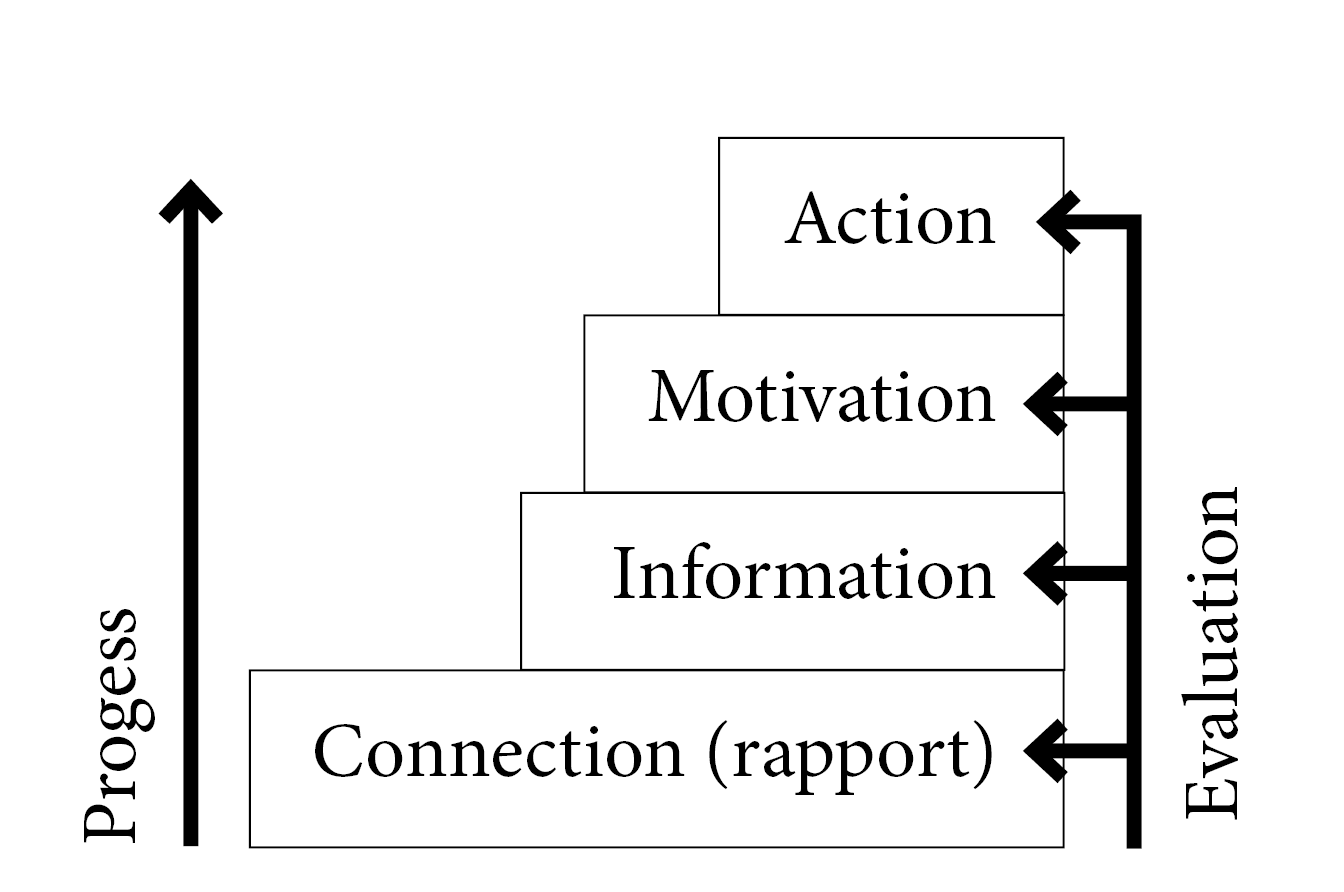
The model has four stages: connection, information, motivation and action.
- Connection (rapport): Gain a deep understanding of the patient’s perspective, while proving trustworthy and building a personal connection. You can use aspects of motivational interviewing, such as active and reflective listening. Having a non-judgemental attitude is critical – focus on sending signals that you’re both on the same team.
- Information: Gradually provide the patient with information, adapted to their health literacy, about their oral health by explaining the diagnosis, causes, and treatment, linking it all to the importance of behavioural change. For example, linking smoking cessation to a reduced risk of tooth loss. This is a good occasion to use the teach-back method.
- Motivation: Information and insight act as the foundation for motivation. This step is about turning understanding into internal motivation, and helping the patient become ready to set realistic goals. Motivation has to come before the next step – don’t jump directly from giving information to demanding action.
- Action: As a dental professional, you should act as a supportive coach, while the patient takes active steps to change their behaviour. Provide educational materials, make sure to follow up and don’t forget positive reinforcement. Most likely, the patient will relapse, so be ready to maybe go back to a previous stage. You might need to strengthen the connection or provide further education.
A long article in a few lines
This staircase model gives dental professionals a roadmap for what to do and when. See figure (adapted from the original article) for an illustration of the model. But knowing how to do it obviously requires some knowledge of the four established behavioural theories mentioned earlier.
In addition to the model, this 18-page article provides a pedagogical framework to help us remember and use motivational interviewing (MI) more. It also discusses brief interventions such as the 5A’s (Ask, Advise, Assess, Assist Arrange) and provides three case studies from periodontal practice. If you want to dig into the article more, it’s open access and the link is below.
References
- https://worldpopulationreview.com/country-rankings/smoking-rates-by-country#top-10-countries-with-the-highest-smoking-rates
- Kowalski J et al. Navigating the dual burden of dental and periodontal care in individuals who also smoke: an expert review. J Dent. 2025 Jun;157:105744. Navigating the dual burden of dental and periodontal care in individuals who also smoke: an expert review - PubMed
- Ramseier CA. An integrated behavioral change model for smoking cessation in periodontal care: The four-stage behavioral support staircase. Periodontol 2000. 2026 Apr 9. An integrated behavioral change model for smoking cessation in periodontal care: The four-stage behavioral support staircase - PubMed
